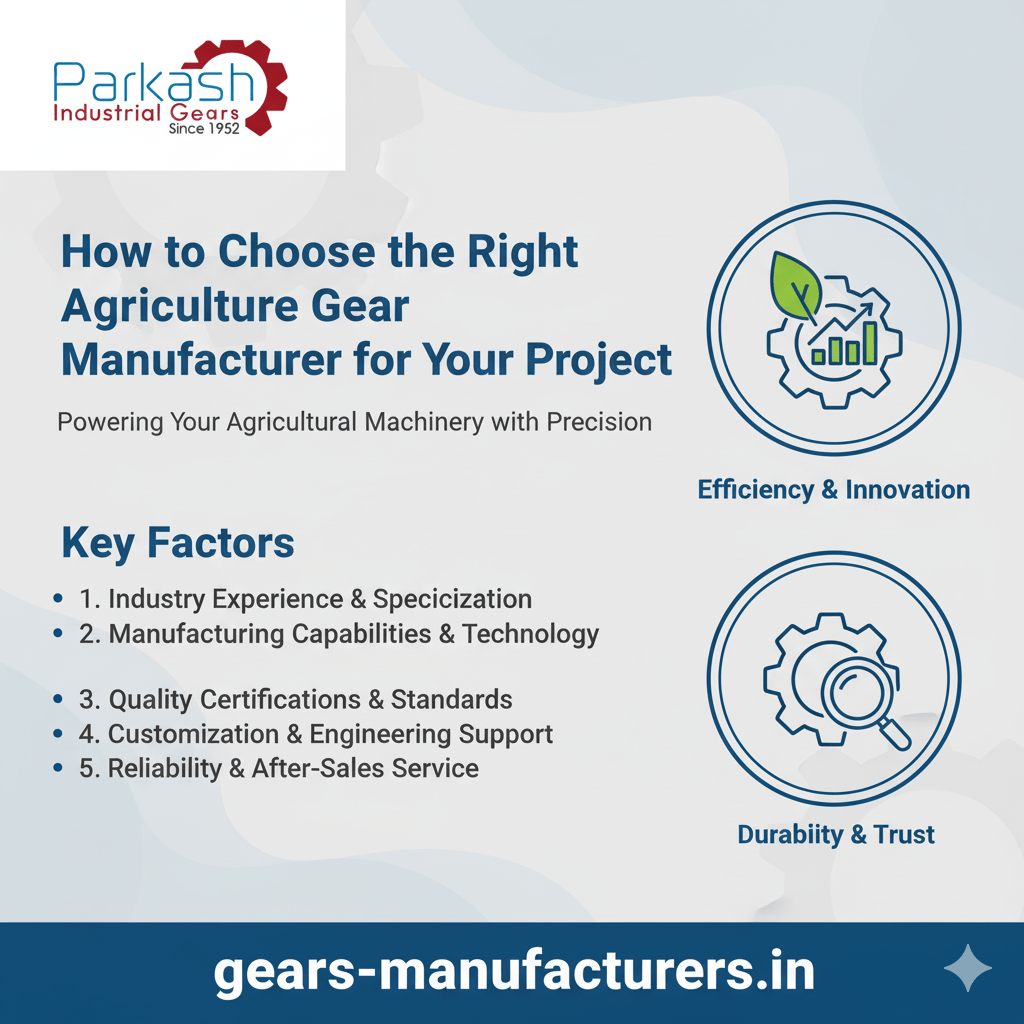
Farm machinery doesn’t forgive poor choices. When your harvester breaks down mid-season or your tractor transmission fails during planting, you realize that the gears driving these machines are the unsung heroes of agricultural productivity. Yet, selecting an agriculture gear manufacturer remains one of the most overlooked decisions in project planning.
For buyers, OEMs, and farm machinery companies, this choice directly impacts operational efficiency, maintenance costs, and ultimately, profit margins. Here’s your comprehensive guide to making a smarter, more strategic decision.
Why Your Gear Manufacturer Choice Matters More Than You Think
Agricultural equipment operates under brutal conditions—extreme temperatures, heavy loads, abrasive materials, and continuous operation during critical seasons. The agriculture gear manufacturer you partner with doesn’t just supply components; they become a critical link in your supply chain reliability.
A recent industry survey revealed that 64% of farm equipment downtime stems from drivetrain failures, with gear-related issues accounting for nearly half of these incidents. This statistic alone justifies a rigorous selection process.
The 7 Essential Selection Criteria
1. Manufacturing Capacity: Can They Scale With Your Needs?
Production capacity determines whether your manufacturer can handle both current orders and future growth. Ask these critical questions:
- What is their monthly output for agricultural gears?
- Do they have dedicated production lines or shared facilities?
- Can they accommodate seasonal demand fluctuations common in agriculture?
- What’s their track record with large-volume orders?
A capable agriculture gear manufacturer should demonstrate flexibility in scaling production without compromising quality. Parkash Industrial Gears, for instance, has established infrastructure that balances batch production with custom requirements, ensuring consistent supply even during peak agricultural seasons.
2. Technology and Precision: The Backbone of Durability
Modern agricultural gears require precision that wasn’t necessary a decade ago. Examine the manufacturer’s technological capabilities:
Key Technology Indicators:
- CNC gear cutting and grinding machines
- Quality control systems (CMM machines, gear analyzers)
- Heat treatment facilities for hardening
- CAD/CAM design capabilities
- Material testing laboratories
The same manufacturer might also serve as a cement gear manufacturer or spur gear manufacturer, indicating versatility in handling different industrial applications. This cross-industry experience often translates to better problem-solving capabilities and innovative solutions for agricultural challenges.
CHECKPOINT FOR BUYERS: Before you sign that contract, walk the factory floor. The machinery you see today will determine the quality you receive tomorrow. OEMs and farm machinery companies should insist on facility audits as part of due diligence.
3. Lead Times: Speed Without Sacrificing Quality
Time-to-market can make or break agricultural equipment launches. Evaluate the manufacturer’s timeline transparency:
- Standard production lead times for different gear types
- Rush order capabilities and associated costs
- Historical on-time delivery rates
- Communication protocols for order tracking
An experienced agriculture gear manufacturer understands that planting and harvest seasons wait for no one. They should offer realistic timelines with buffer periods built in, rather than over-promising and under-delivering.
4. Custom Capability: Beyond Off-the-Shelf Solutions
Agricultural applications vary dramatically—from compact tillers to massive combine harvesters. Your manufacturer must demonstrate:
- Engineering support for custom gear design
- Prototyping capabilities
- Willingness to work with your specifications
- Experience with unusual gear profiles or materials
The ability to function as both a cement gear manufacturer and spur gear manufacturer often indicates a robust custom fabrication capability, as these sectors demand different specifications and tolerances.
5. After-Sales Support: The Partnership Beyond Purchase
A transaction doesn’t end at delivery. Evaluate the manufacturer’s commitment to ongoing support:
Critical Support Elements:
- Technical consultation availability
- Warranty terms and claim processes
- Replacement part accessibility
- Troubleshooting assistance
- Documentation quality (installation guides, maintenance manuals)
Leading manufacturers like Parkash Industrial Gears recognize that customer success drives repeat business, offering comprehensive support that extends well beyond the initial sale.
6. Geographic Proximity: Balancing Convenience and Cost
Location impacts logistics, communication, and response times. Consider these factors:
- Shipping costs and transit times
- Time zone alignment for real-time communication
- Ease of conducting site visits or audits
- Import duties and customs considerations (for international suppliers)
While global sourcing offers cost advantages, a regional agriculture gear manufacturer can provide faster turnaround for urgent requirements and simplified logistics management.
7. Cost Structure: Total Cost of Ownership Analysis
Price alone is misleading. Calculate the true total cost:
- Unit price per gear
- Tooling and setup fees for custom orders
- Shipping and handling costs
- Quality-related expenses (rejection rates, warranty claims)
- Inventory carrying costs based on lead times
An agriculture gear manufacturer offering the lowest upfront price might cost significantly more if quality issues lead to field failures or excessive warranty claims.
Making Your Final Decision: A Practical Checklist
Before committing to an agriculture gear manufacturer, verify:
✓ Request samples and conduct independent quality testing
✓ Check industry certifications (ISO 9001, industry-specific standards)
✓ Review client testimonials and case studies
✓ Negotiate clear SLAs covering delivery, quality, and support
✓ Establish contingency plans for supply disruptions
✓ Verify financial stability (especially for long-term partnerships)
The Bottom Line
Choosing an agriculture gear manufacturer isn’t about finding the cheapest supplier—it’s about identifying a partner capable of supporting your project’s success from design through decades of field operation. Companies like Parkash Industrial Gears exemplify the balance between manufacturing excellence, technical capability, and customer commitment that defines a reliable partner.
Whether you’re an OEM developing next-generation farm equipment or a buyer sourcing replacement components, applying these criteria systematically will minimize risk and maximize the return on your manufacturing partnership. The right agriculture gear manufacturer doesn’t just deliver gears—they deliver peace of mind that your machinery will perform when it matters most.
Ready to evaluate your options? Start by requesting facility audits and sample parts from your shortlisted manufacturers. Your due diligence today prevents costly failures tomorrow.
 Best Spur Gears Manufacturer in India